


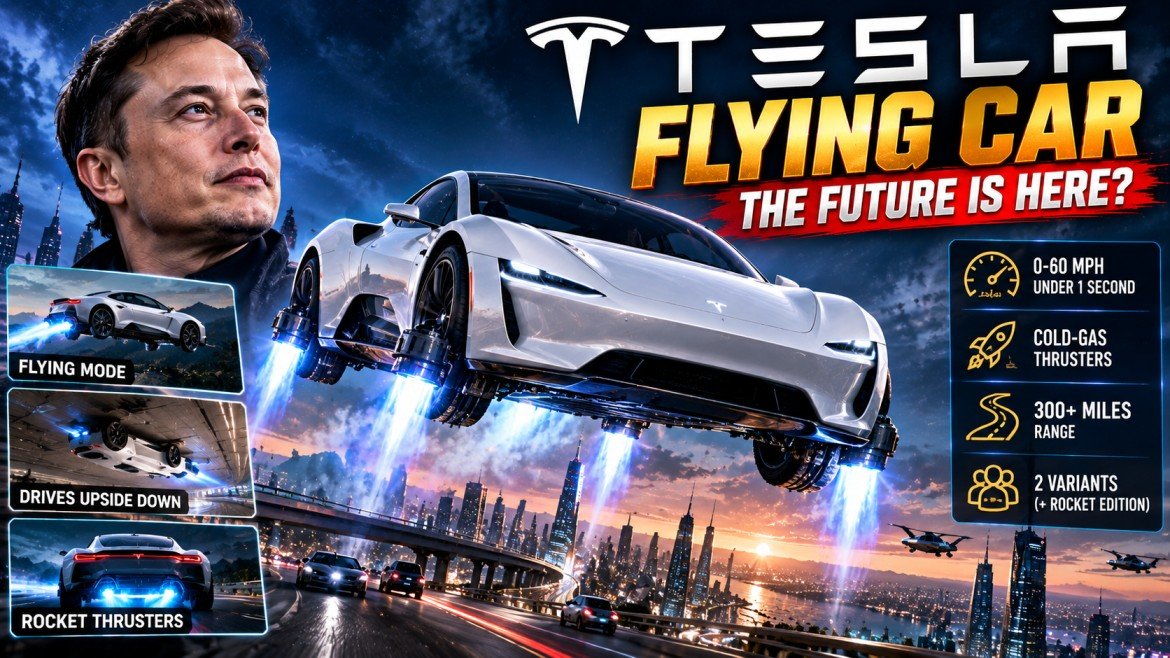
Imagine driving a car that accelerates faster than almost anything on the road, travels upside down and launches itself into the air using advanced rocket-inspired technology.
For decades, flying cars have existed mainly in science-fiction movies. Now, Elon Musk and Tesla are attempting to bring part of that futuristic vision into reality.
The tesla flying car has become one of the most exciting developments in automotive technology after Tesla demonstrated a new version of its Roadster electric sports car at a SpaceX facility in Texas.
Unlike conventional electric vehicles, the redesigned Roadster uses advanced cold-gas thrusters and a special suction system to perform extraordinary movements.
During the demonstration, the prototype drove upside down, launched into the air, rotated mid-flight and landed.
The event generated enormous attention because it suggested that the boundary between automotive and aerospace technology could become increasingly blurred.
However, the vehicle is not yet a commercially available flying car, and several technical and regulatory challenges remain.
In this NewsWavvy guide, we explore the tesla flying car, its technology, demonstration, expected price, production plans, variants, potential advantages and the challenges that could determine its future.
Tesla Flying Car: Quick Overview
| Feature | Details |
|---|---|
| Vehicle | Tesla Roadster |
| Company | Tesla |
| CEO | Elon Musk |
| Technology Partner | SpaceX |
| Vehicle Type | Electric sports car with aerospace-inspired systems |
| Flight Technology | Cold-gas thrusters |
| Special Feature | Mid-air manoeuvring |
| Acceleration Claim | 0–60 mph in under 1 second |
| Announced Top Speed | Over 230 mph |
| Announced Range | Over 300 miles |
| Special Versions | Performance, Thrust and Rocket |
| Production Target | 2028 |
| Final Retail Price | Not announced |
| Public Road Approval for Rocket | Not approved |
Important: Performance specifications are based on Tesla’s demonstration and company announcements. Consumer-production performance has not been independently established.
What Is the Tesla Flying Car?
The term tesla flying car refers to Tesla’s next-generation Roadster, particularly its experimental Rocket configuration.
The Roadster is designed primarily as an extremely high-performance electric sports car.
However, the flight-capable version combines electric vehicle technology with aerospace-inspired propulsion.
Instead of relying on large airplane wings or helicopter rotors, the special Roadster uses high-pressure gas thrusters to create powerful directional forces.
These forces can help the vehicle:
- Accelerate rapidly
- Launch into the air
- Rotate during airborne manoeuvres
- Stabilise its position
- Perform specialised driving stunts
The car also uses a fan-based suction system that can create substantial downward force.
This allows the prototype to demonstrate movements that ordinary vehicles cannot perform.
However, brief airborne movement is different from sustained, practical flight between destinations.
Tesla has demonstrated impressive capabilities, but it has not established that the Roadster can operate as an everyday aircraft.
Elon Musk Unveils Tesla Flying Car
The major public demonstration took place on October 15 at a SpaceX testing facility in Texas.
The redesigned Roadster appeared in a dramatic presentation featuring a futuristic vehicle design and advanced engineering systems.
Rather than simply revealing a stationary car, Tesla showcased its capabilities through several unusual stunts.
The demonstration included:
- Driving up a steep, curved ramp.
- Remaining attached while travelling upside down.
- Launching into the air.
- Rotating during flight.
- Landing back on its wheels.
- Performing additional jumps using its thrusters.
The vehicle was operated remotely or autonomously during the demonstration as a safety precaution.
This was significant because the company showed working prototype technology rather than only releasing computer-generated concept images.
Still, a successful controlled demonstration is not the same as certification for consumer use.
How Does the Tesla Flying Car Work?
The technology behind the Roadster is fascinating because it combines several different engineering systems.
1. Cold-Gas Thrusters
The most important technology is the cold-gas thruster system.
Traditional rocket engines often burn fuel to produce high-speed exhaust gases.
Cold-gas thrusters work differently.
They release stored pressurised gas through nozzles to generate thrust.
By controlling the direction and duration of the gas release, engineers can influence the vehicle’s movement.
This technology is particularly interesting for controlled, short-duration manoeuvres.
How It Helps the Roadster
Cold-gas thrusters can provide additional forces beyond those created by the wheels and electric motors.
They may assist with:
- Rapid acceleration
- Airborne rotation
- Directional control
- Short jumps
- Stabilisation during specialised manoeuvres
However, high-pressure gas storage creates additional engineering and safety challenges.
2. SpaceX-Inspired Technology
Tesla collaborated with SpaceX on the Roadster’s advanced systems.
Both companies are associated with Elon Musk, but they specialise in different technologies.
Tesla focuses on electric vehicles, batteries, software and automation.
SpaceX develops rocket engines, spacecraft and other aerospace systems.
The new Roadster attempts to combine expertise from both industries.
This makes the project different from a conventional electric supercar.
Rather than improving only horsepower and battery performance, Tesla is exploring propulsion methods outside the standard automotive design.
3. Multi-Mode Suction System
Another unusual Roadster feature is its fan-based suction system.
The system pulls air from underneath the vehicle to create strong downward force.
This is known as downforce.
In ordinary performance cars, aerodynamic downforce helps tyres maintain contact with the road.
Tesla’s approach is designed to produce extremely high downforce even at low speeds.
The system was central to the Roadster’s ability to travel upside down during the demonstration.
However, this capability depends on suitable surfaces, the vehicle’s sealing system and carefully controlled conditions.
It does not mean the car can automatically drive upside down on any ordinary road or ceiling.
4. Advanced Electric Powertrain
Despite its aerospace-inspired equipment, the Roadster remains an electric vehicle.
Its electric drivetrain provides the foundation for normal road performance.
Electric motors can deliver torque rapidly, making them particularly effective for high-performance acceleration.
Tesla combines this advantage with additional technologies such as:
- Active aerodynamics
- Electronic steering controls
- Advanced traction management
- Specialised suspension
- High-performance cooling
The goal is to produce a vehicle that pushes beyond conventional sports-car performance.
Tesla Flying Car Variants Explained
Tesla’s updated Roadster lineup includes three different configurations.
1. Performance
The Performance model is positioned as the road-focused version.
It features a two-seat layout and advanced aerodynamic technology.
Its main purpose is extreme electric sports-car performance rather than flight.
2. Thrust
The Thrust version introduces additional cold-gas propulsion technology.
Tesla describes it as a limited-release performance configuration.
Its rear-mounted thrusters are designed to create extraordinary acceleration.
The company has promoted a 0–60 mph time below one second.
3. Rocket
The Rocket version is the most extreme configuration.
Tesla describes it as invitation-only.
Unlike the two-seat versions, the Rocket configuration has a single-seat arrangement.
It uses thrusters positioned around the vehicle to support more complex directional movement.
Tesla identifies this configuration as flight-capable.
However, it is not approved for public road use.
Tesla Roadster Comparison
| Feature | Performance | Thrust | Rocket |
|---|---|---|---|
| Main Purpose | Road performance | Extreme acceleration | Experimental flight capability |
| Seating | Two | Two | One |
| Thrusters | No flight system | Rear propulsion | Multiple directional thrusters |
| Availability | Reservation | Limited release | Invitation only |
| Everyday Road Use | Intended | Subject to approvals | Not approved |
These configurations help explain an important distinction: not every Tesla Roadster is intended to fly.
Tesla Flying Car Speed and Acceleration
One of the most remarkable claims surrounding the vehicle involves acceleration.
Tesla says the new Roadster can reach 60 mph from a standstill in less than one second in its specialised thruster-equipped configuration.
That is approximately 97 km/h.
For comparison, even many high-performance electric supercars require considerably longer to achieve this speed.
Such extreme acceleration requires sophisticated engineering.
The tyres, traction systems, propulsion hardware and vehicle structure must all handle powerful forces.
The demonstration suggests that Tesla is pushing beyond the performance limitations of conventional road cars.
However, the claimed acceleration should not be interpreted as a verified specification for every version.
Real-world performance may depend on:
- Vehicle configuration
- Tyre conditions
- Road surface
- Ambient temperature
- Thruster availability
- Safety restrictions
Independent testing of production vehicles will be important.
Tesla Flying Car Top Speed
Tesla’s updated Roadster presentation also discussed a top speed exceeding 230 mph.
That is more than 370 km/h.
This figure positions the vehicle within the extreme supercar category.
However, there is a difference between a manufacturer’s projected capability and an independently verified record.
The eventual top speed may depend on the final production design.
It is also important to understand that Roadster top speed refers primarily to ground performance.
It does not mean the vehicle has demonstrated sustained airborne travel at such speeds.
Tesla Flying Car Battery and Range
Battery performance remains essential, even for a car equipped with thrusters.
Tesla’s recent presentation indicated an electric driving range exceeding 300 miles, or approximately 480 kilometres.
Earlier Roadster announcements had discussed a significantly longer range.
The difference illustrates why buyers should rely on updated product information rather than old concept specifications.
Actual driving range can depend on:
- Vehicle speed
- Driving style
- Weather
- Terrain
- Battery temperature
- Tyre choice
- Use of performance systems
Specialised thruster hardware also introduces questions about weight, packaging and operating efficiency.
Independent road tests will be necessary to establish the final production vehicle’s real-world range.
Can the Tesla Flying Car Really Fly?
Yes, Tesla has demonstrated a prototype capable of brief airborne movement and controlled rotation.
However, there is an important distinction between performing a short airborne stunt and operating as a fully functional flying vehicle.
A practical flying car would need to demonstrate capabilities such as:
- Reliable takeoff
- Sustained flight
- Controlled navigation
- Safe landing
- Emergency procedures
- Suitable operating range
- Aviation regulatory approval
The Roadster demonstration showed that the prototype could use propulsion to leave the ground and control certain movements.
It did not prove that ordinary buyers could use the vehicle to fly above traffic between cities.
This is the central distinction readers should understand when following news about the tesla flying car.
Tesla Flying Car vs Traditional Flying Cars
Tesla’s approach differs from many other flying-vehicle projects.
Some companies are developing electric vertical takeoff and landing aircraft, commonly known as eVTOLs.
These vehicles typically rely on multiple propellers or rotors.
Others are attempting to build cars that can drive on roads and also take off vertically.
Tesla’s Roadster is different.
It starts with a high-performance sports-car platform and adds specialised propulsion systems.
| Feature | Tesla Roadster Rocket | Typical eVTOL Aircraft |
|---|---|---|
| Main Design | Sports car | Aircraft |
| Main Propulsion | Electric drivetrain and cold-gas thrusters | Electric rotors or fans |
| Road Driving | Experimental configuration | Usually not designed for roads |
| Airborne Capability | Short demonstrated manoeuvres | Intended for sustained flight |
| Practical Passenger Transport | Not established | Central design goal |
| Commercial Status | Future limited product | Varies by developer |
Both approaches face significant engineering and regulatory challenges.
Is Tesla Flying Car the Same as Alef Flying Car?
No.
Tesla and Alef Aeronautics are separate companies.
Alef is developing a vehicle intended to operate on roads and take off vertically.
Its concept focuses on combining road transportation with practical airborne travel.
Tesla’s rocket-assisted Roadster instead prioritises sports-car performance and extraordinary propulsion capabilities.
Both projects contribute to public discussion about flying cars, but they follow different engineering approaches.
They should not be confused with one another.
Tesla Flying Car Expected Price
Tesla has not announced the final retail price of its updated Roadster lineup.
This is important because some websites confuse reservation deposits with purchase prices.
Following the unveiling, reported reservation requirements included:
| Configuration | Reported Deposit |
|---|---|
| Performance | $50,000 |
| Thrust | $250,000 |
| Rocket | Invitation only |
These amounts represent reservation requirements, not confirmed final vehicle prices.
Tesla previously discussed a starting price of approximately $200,000 for an earlier version of the Roadster, but that figure should not be assumed to apply to the redesigned model.
The final price could depend on:
- Production costs
- Variant
- Thruster technology
- Materials
- Battery system
- Exclusivity
- Regulatory requirements
The Rocket version is likely to appeal to a highly specialised group of buyers rather than the mass automotive market.
Tesla Flying Car Price in India
Indian buyers are also interested in the possible cost of the Tesla flying car.
However, there is currently no confirmed final India retail price.
A direct currency conversion of a US reservation deposit does not establish the vehicle’s Indian on-road price.
Pricing could be affected by:
- Import duties
- Local taxes
- Exchange rates
- Vehicle specifications
- Availability
- Registration requirements
The Rocket configuration also presents major legal questions because it is not approved for public road use.
Therefore, a confirmed India delivery date and final on-road price remain unavailable.
Tesla Flying Car Launch Date
Tesla is currently targeting 2028 for the beginning of Roadster production.
However, the company has not guaranteed when every customer will receive a vehicle.
The Roadster has experienced several delays since its next-generation concept was first announced.
That makes production targets different from confirmed delivery dates.
Potential delays could involve:
- Engineering development
- Manufacturing readiness
- Safety testing
- Regulatory approvals
- Production scaling
- Supplier readiness
Customers should wait for official production and delivery updates before treating any projected date as final.
Will Tesla Flying Car Be Available in India?
Availability in India remains uncertain.
Even if a vehicle becomes available for international reservation, that does not automatically mean it can be legally operated on Indian roads.
A flight-capable vehicle could face additional requirements involving automotive and aviation authorities.
The Rocket version would require particularly careful regulatory consideration.
Until official approvals and delivery arrangements are announced, Indian buyers should not assume that they will be able to purchase and operate the vehicle locally.
Is the Tesla Flying Car Safe?
Safety is one of the biggest questions surrounding the technology.
Ordinary road cars are engineered to protect passengers during predictable driving conditions and collisions.
A vehicle capable of launching itself into the air introduces additional challenges.
These include:
High Acceleration Forces
Extremely rapid acceleration can place substantial physical stress on occupants.
Landing Impact
A vehicle that becomes airborne must manage the forces created when returning to the ground.
Thruster Reliability
Directional propulsion systems must function predictably under demanding conditions.
Pressure Systems
High-pressure gas storage requires robust containment and safety engineering.
Surrounding Traffic
Unexpected airborne movement could create risks for nearby road users.
Emergency Situations
Engineers must consider what happens if a propulsion or control system fails.
Tesla conducted its dramatic demonstration without a human driver in the vehicle.
The company has also acknowledged that the Roadster prioritises extraordinary performance rather than being a conventional safety-focused family vehicle.
This reinforces why public use requires more than an impressive demonstration.
What Makes the Tesla Flying Car Different From Ordinary EVs?
Most electric vehicles focus on:
- Battery range
- Charging speed
- Passenger comfort
- Efficiency
- Digital features
- Safety
- Everyday practicality
The Roadster takes a different approach.
It aims to showcase extreme engineering possibilities.
Rather than trying to be the most practical electric car, it is intended to demonstrate the technical capabilities of Tesla and SpaceX.
This type of vehicle is sometimes described as a halo car.
A halo car helps build excitement around an automotive brand through unusual design, technology and performance.
It may not sell in large numbers, but it can attract attention and influence future engineering development.
Could Tesla Flying Cars Replace Traditional Vehicles?
Not in the near future.
Even if the Roadster’s flight systems become more advanced, replacing ordinary cars would require solving several major problems.
Air Traffic Management
Thousands of airborne vehicles would require extensive coordination.
Infrastructure
Cities may need specialised landing areas, maintenance facilities and operating zones.
Noise
Propulsion systems could create significant sound concerns.
Energy Efficiency
Flying generally requires more energy than travelling on wheels over a comparable distance.
Cost
Advanced aerospace technology could make flying vehicles expensive to manufacture and maintain.
Regulations
Governments would need clear rules covering operating permissions, safety and liability.
For these reasons, ordinary electric vehicles are likely to remain much more practical for everyday transportation.
Could the Tesla Flying Car Help Reduce Traffic?
Flying cars are often presented as a solution to road congestion.
In theory, moving some journeys into the air could reduce pressure on roads.
However, this depends on scale and operating conditions.
A limited production sports car cannot meaningfully change urban traffic.
A successful mass-market flying-vehicle system would require safe and affordable services for many passengers.
Tesla has not presented its Rocket Roadster as a realistic large-scale urban transportation network.
For now, its biggest value is as an engineering demonstration.
Why Elon Musk Is Interested in Flying Cars
Elon Musk has repeatedly pursued technologies that challenge traditional engineering limits.
Tesla helped accelerate public interest in electric vehicles.
SpaceX developed reusable orbital rocket systems.
The Roadster brings together parts of these two industries.
Its purpose is not necessarily to become the next everyday commuter car.
Instead, the project challenges assumptions about what a sports car can physically do.
The concept also gives engineers opportunities to experiment with:
- Propulsion
- Aerodynamics
- Control systems
- Materials
- Vehicle stability
- Performance optimisation
Whether all of these technologies eventually reach mainstream vehicles remains uncertain.
Biggest Challenges Facing the Tesla Flying Car
Despite the successful demonstration, several questions remain unanswered.
Can Tesla Manufacture the Technology Reliably?
Building one experimental prototype is very different from manufacturing dozens or hundreds of vehicles consistently.
How Long Can the Vehicle Remain Airborne?
Tesla has demonstrated brief airborne manoeuvres, not routine sustained flight.
Will Regulators Approve It?
The Rocket version is not approved for public roads.
Can the System Be Operated Safely?
Tesla will need to demonstrate appropriate reliability and safety performance.
What Will the Final Price Be?
No confirmed final retail price has been announced.
Will Production Begin on Schedule?
The Roadster has experienced previous delays, so its latest production target is not a guarantee.
These questions will determine whether the project becomes a practical limited-production vehicle or remains primarily an experimental engineering showcase.
Is the Tesla Flying Car Worth Waiting For?
That depends on what buyers expect.
For someone looking for a practical electric vehicle, waiting several years for the Roadster is unlikely to make sense.
Tesla and other manufacturers already offer road-oriented electric vehicles designed for daily transportation.
But for collectors, engineering enthusiasts and buyers interested in extreme automotive performance, the Roadster could be a fascinating future product.
Its most distinctive appeal lies in the combination of electric-car performance and aerospace-inspired propulsion.
Still, prospective buyers should consider the uncertainty around production, price, safety certification and delivery.
What Does the Tesla Flying Car Mean for the Future?
The Roadster demonstration does not mean flying cars will soon become common on public roads.
However, it demonstrates that automotive manufacturers are exploring increasingly unconventional ideas.
The long-term benefits may emerge in unexpected ways.
Advanced propulsion and control systems could influence specialised vehicles, motorsport or experimental mobility technologies.
Similarly, aerodynamic improvements and high-performance electrical systems can sometimes lead to broader engineering developments.
The most important achievement may not be creating a car that briefly flies.
It may be demonstrating new ways to combine technologies from different industries.
Final Thoughts
The tesla flying car is one of the most unusual automotive projects associated with Elon Musk.
Tesla has moved beyond concept images by demonstrating a Roadster prototype capable of travelling upside down, launching into the air and performing controlled airborne manoeuvres.
The combination of cold-gas thrusters, advanced aerodynamics, electric propulsion and SpaceX engineering makes the vehicle fundamentally different from an ordinary electric sports car.
Its acceleration claims are equally ambitious.
However, the demonstration should not be confused with the arrival of a practical flying vehicle.
The flight-capable Rocket configuration remains invitation-only, is not approved for public road use and has no guaranteed customer delivery schedule.
Production is targeted for 2028, but further engineering, manufacturing and regulatory work remains.
For now, Tesla’s Roadster represents an extraordinary experiment in automotive performance.
Whether it eventually transforms transportation or remains a rare engineering showcase, it has already reopened one of technology’s oldest questions:
What if the car of the future could do more than drive?
FAQ About Tesla Flying Car
1. What Is the Tesla Flying Car?
The tesla flying car refers to Tesla’s next-generation Roadster, particularly the Rocket configuration that uses cold-gas thrusters for airborne manoeuvres.
2. Has Tesla Really Made a Flying Car?
Tesla has demonstrated a working prototype capable of brief airborne movements and rotation. It has not demonstrated a conventional aircraft designed for routine passenger flights.
3. Who Created the Tesla Flying Car?
Tesla developed the Roadster with engineering contributions from SpaceX. Both companies are associated with Elon Musk.
4. When Was the Tesla Flying Car Revealed?
Tesla demonstrated the redesigned Roadster on October 15 at a SpaceX facility in Texas.
5. When Will Tesla Flying Car Launch?
Tesla currently targets 2028 for production, but the company has not guaranteed consumer deliveries.
6. What Is the Tesla Flying Car Price?
Tesla has not announced final retail pricing for the redesigned Roadster lineup.
7. How Much Does It Cost to Reserve a Tesla Roadster?
Reported deposits include $50,000 for the Performance version and $250,000 for the Thrust version. These are not final purchase prices.
8. Can Tesla Flying Car Fly Like an Airplane?
No practical sustained airplane-style flight has been demonstrated. Tesla has shown short airborne manoeuvres using thrusters.
9. What Technology Makes the Tesla Roadster Fly?
The special Rocket version uses advanced cold-gas thrusters that generate directional force through compressed gas.
10. Is SpaceX Involved in Tesla Flying Car?
Yes. SpaceX contributed aerospace-related technology and engineering expertise to the Roadster project.
11. How Fast Is the Tesla Flying Car?
Tesla has claimed a 0–60 mph acceleration time below one second for a specialised Roadster configuration.
12. What Is the Tesla Flying Car Top Speed?
The company has discussed a top speed exceeding 230 mph for the redesigned Roadster.
13. What Is the Tesla Roadster Driving Range?
Tesla’s latest presentation indicated a range exceeding 300 miles, although final production figures require verification.
14. Is Tesla Flying Car Available in India?
There is no confirmed customer delivery date or legal operating approval for the Rocket configuration in India.
15. Can the Tesla Roadster Drive Upside Down?
The demonstration prototype used a powerful suction system to travel upside down along a specially designed ramp.
16. Is Tesla Flying Car Street Legal?
The Rocket version is not approved for public road use.
17. How Many People Can Sit in the Tesla Flying Car?
Tesla describes the Rocket version as a single-seat configuration. The Performance and Thrust versions have two seats.
18. Is the Tesla Flying Car Electric?
Yes. The Roadster uses an electric drivetrain, with additional propulsion technology in specialised configurations.
19. Is Tesla Flying Car the Same as Alef Flying Car?
No. Alef Aeronautics is an independent company developing its own flying-car technology.
20. Will Flying Cars Replace Normal Cars?
Not anytime soon. Safety, cost, energy efficiency, regulations and infrastructure remain significant challenges.
21. Can Anyone Buy the Tesla Rocket Roadster?
No. Tesla describes the Rocket version as invitation-only, and it is not currently a generally available retail product.
22. Why Is the Tesla Flying Car Famous?
It attracted attention after Tesla demonstrated a Roadster travelling upside down and performing airborne manoeuvres using rocket-inspired propulsion technology.