


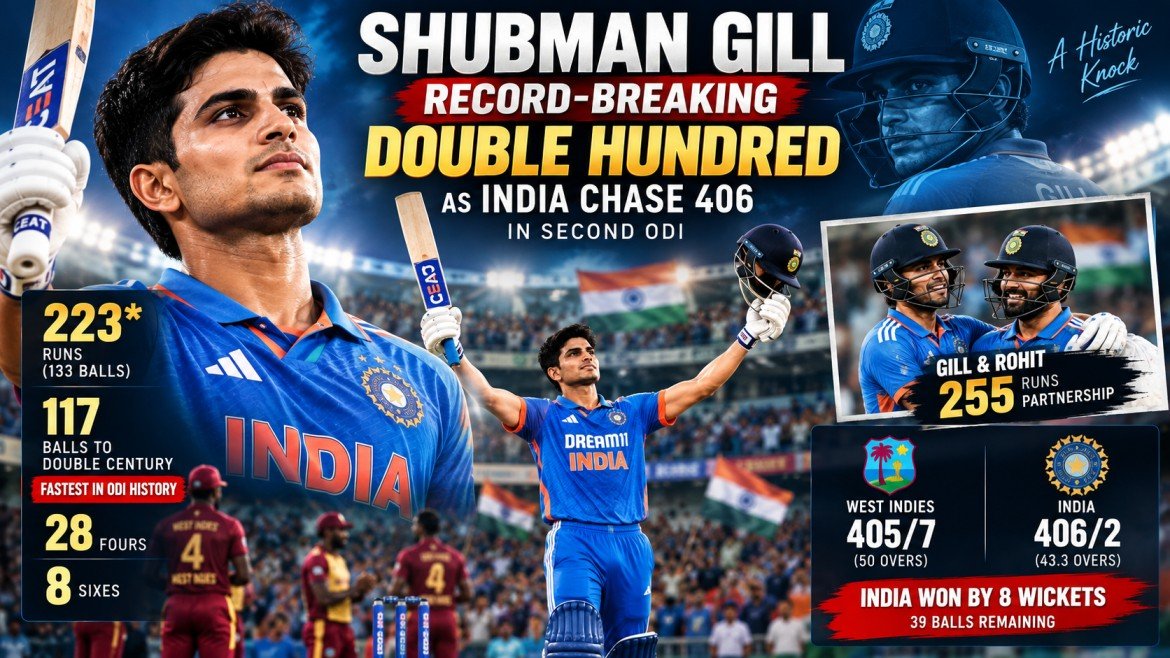
Indian cricket witnessed one of its most extraordinary ODI run chases when Shubman Gill hits record-breaking double hundred as India chase 406 in second ODI against West Indies at the Barsapara Cricket Stadium in Guwahati.
Chasing an enormous target of 406, India needed something exceptional.
They got exactly that from captain Shubman Gill.
Gill produced an unbeaten 223 from 133 deliveries, combining timing, power and remarkable composure to lead India to an eight-wicket victory.
He reached his double century from only 117 balls, breaking the record for the fastest 200 in ODI cricket.
Rohit Sharma also played a major role, scoring 101 and sharing a massive opening partnership with Gill.
India eventually completed the chase in only 43.3 overs, with 39 deliveries still unused.
This NewsWavvy guide looks at Shubman Gill’s historic double century, India’s record-breaking chase, the records broken during the match and why this innings could become one of the defining performances of Gill’s career.
Shubman Gill Double Century: Quick Match Facts
| Detail | Record |
|---|---|
| Match | India vs West Indies, Second ODI |
| Venue | Barsapara Cricket Stadium, Guwahati |
| Target | 406 |
| Shubman Gill | 223 not out |
| Balls Faced | 133 |
| Double Century | 117 balls |
| Rohit Sharma | 101 |
| Opening Partnership | 255 runs |
| India Score | 406/2 |
| Overs | 43.3 |
| Result | India won by 8 wickets |
| Series Status | India took an unassailable lead |
Gill’s 117-ball double century became the fastest in ODI history, beating Ishan Kishan’s previous 126-ball mark.
How West Indies Reached 405
Before Gill’s historic innings, West Indies had already produced one of their finest ODI batting performances.
They finished with 405/7, their first 400-plus total in ODI cricket.
Three West Indies batters scored centuries:
- John Campbell
- Shai Hope
- Amir Jangoo
That alone made the innings remarkable.
Scoring 405 usually puts a team in a commanding position.
In most ODI matches, a target above 400 almost guarantees enormous scoreboard pressure.
West Indies therefore entered the second innings expecting India to face one of the toughest chases in ODI history.
Instead, the target became the setting for one of India’s greatest batting performances.
Reuters reported that West Indies’ 405/7 was their first 400-plus ODI total and included three individual centuries.
India Needed a Perfect Start
A target of 406 does not allow a batting team to spend 15 overs simply settling into the innings.
India needed boundaries from the beginning.
More importantly, they needed wickets in hand.
Shubman Gill and Rohit Sharma created the perfect balance.
They attacked without becoming reckless.
Both batters consistently punished poor deliveries while keeping the required run rate under control.
By the time West Indies finally found a breakthrough, India had already built one of the most destructive opening partnerships in ODI cricket.
Shubman Gill and Rohit Sharma’s 255-Run Partnership
Gill and Rohit added 255 runs for the opening wicket.
The partnership transformed the chase.
Instead of India appearing under pressure from a 406-run target, West Indies suddenly found themselves desperate for a wicket.
Rohit scored a brilliant 101 from 75 balls before being dismissed.
Gill simply continued.
The ICC described the 255-run partnership as India’s highest ODI partnership on home soil.
Rohit Sharma’s Century
Rohit Sharma’s hundred could easily have been the biggest story in another match.
He reached his 35th ODI century and provided India with exactly the aggressive support Gill needed.
His innings helped ensure that the required run rate never became impossible.
Rohit attacked from one end while Gill built what eventually became a historic score from the other.
The partnership also demonstrated something extremely important about successful high-pressure chases:
One batter can play a great innings.
But chasing 400 usually requires multiple extraordinary contributions.
Rohit ensured Gill was never fighting alone.
Shubman Gill Reaches His Century in 62 Balls
Gill reached his hundred from only 62 deliveries.
That was already an exceptionally fast ODI century.
It also became the fastest ODI hundred by an Indian captain.
But reaching 100 was only the beginning.
Gill accelerated further.
Instead of slowing down after the milestone, he continued attacking West Indies’ bowlers and quickly moved toward 150.
At that stage, the possibility of a double century became realistic.
Indian Express reported that Gill’s century came from 62 balls before he reached 200 from just 117 deliveries.
The Record-Breaking Double Century
Gill reached 200 from his 117th ball.
That made it the fastest double century in ODI history.
The previous record belonged to Ishan Kishan.
Fastest ODI Double Centuries
Shubman Gill – 117 balls
Against West Indies in Guwahati.
Ishan Kishan – 126 balls
Against Bangladesh in Chattogram.
Glenn Maxwell – 128 balls
Against Afghanistan.
Pathum Nissanka – 136 balls
Against Afghanistan.
Chris Gayle – 138 balls
Against Zimbabwe.
Gill did not simply improve the record.
He improved it by nine deliveries.
In ODI cricket, that is a significant gap.
The ICC and contemporary match reporting confirmed Gill’s 117-ball landmark as the new world record.
Shubman Gill Finishes on 223 Not Out
Gill eventually finished unbeaten on 223 from 133 balls.
His innings included:
- 28 fours
- 8 sixes
The score demonstrated that his innings was not built only around six-hitting.
Much of Gill’s batting came from traditional stroke-making.
He repeatedly found boundaries through timing, placement and excellent footwork.
That is what makes his ODI batting especially dangerous.
Gill does not need to hit every delivery into the stands.
He can score rapidly through conventional cricket shots and then increase the power when required.
Gill’s Strike Rate
Gill scored 223 runs from 133 deliveries.
That produced a strike rate of approximately 167.67.
Maintaining that strike rate for more than 200 runs is extraordinary.
It means Gill did not simply play a short explosive cameo.
He maintained elite scoring speed for almost an entire innings.
The longer a batter stays at the crease, the harder it usually becomes to maintain extreme aggression because fatigue increases and bowlers constantly adjust.
Gill managed both.
Gill Becomes Only Second Batter With Multiple ODI Double Hundreds
The innings was also Gill’s second ODI double century.
His first came against New Zealand in Hyderabad, when he scored 208.
That means Gill became only the second player in ODI history to score multiple double hundreds.
The other player is Rohit Sharma.
Rohit remains the only batter with three ODI double centuries.
Gill now sits directly behind him with two.
The achievement is especially remarkable considering Gill is still building his international career.
The Times of India and Indian Express both reported that he became only the second batter after Rohit Sharma to score multiple ODI double centuries.
Gill Breaks Glenn Maxwell’s Chase Record
Another major achievement came because the innings happened during a run chase.
Glenn Maxwell’s famous unbeaten 201 against Afghanistan had been the highest individual score during an ODI chase.
Gill surpassed that mark by reaching 223 not out.
That makes Gill’s innings the highest individual ODI score in a successful run chase.
This is an important distinction.
Scoring 200 while setting a target is extraordinary.
Scoring more than 200 while knowing your team needs 406 creates a completely different type of pressure.
Every phase of the innings is controlled by the target.
Gill had to balance personal acceleration with match awareness.
He did both perfectly.
India Chase 406 in 43.3 Overs
India eventually reached 406/2 in 43.3 overs.
They still had 39 balls remaining.
That tells the complete story of how dominant the chase became.
A target of 406 initially looked enormous.
By the end, India made it appear surprisingly comfortable.
According to the ICC, it became the second-highest successful chase in ODI history.
Why India’s Chase Was Historic
The victory broke several barriers.
More Than 400 Chased Successfully
Chasing 400 remains extremely rare in ODI cricket.
Eight-Wicket Victory
India did not scrape home with one wicket remaining.
They lost only two wickets.
39 Balls Remaining
The chase was completed more than six overs early.
Gill’s Double Century
The fastest ODI 200 became the centrepiece.
Rohit’s Century
India had two centurions during the chase.
Together, these factors make the match one of the most remarkable ODI batting performances ever produced.
Shubman Gill as India Captain
Another layer to the innings was Gill’s role as captain.
Captaincy creates additional responsibility.
A captain must think about:
- Team selection
- Bowling changes
- Field placements
- Match strategy
- Player management
After spending 50 overs managing the match, Gill then had to open the batting in pursuit of 406.
Instead of appearing mentally exhausted, he produced his greatest ODI innings.
Reports also identified Gill as the first captain to score double centuries in both Test and ODI cricket.
Why This Innings Was Different From Gill’s First Double Century
Gill’s first ODI double hundred came against New Zealand.
That innings established his ability to produce huge individual scores.
The West Indies innings added another dimension.
This time, India was chasing 406.
That meant Gill could not simply bat deep and accelerate late.
He needed to score quickly throughout the innings.
The result was a much faster double century.
First Double Century
208 against New Zealand.
Second Double Century
223 not out against West Indies.
Major Difference
The second came while chasing a massive target and became the fastest ODI 200 ever recorded.
Gill’s Rise as One of ODI Cricket’s Best Batters
Gill’s technique has always made him particularly suited to ODI cricket.
He combines:
- Timing
- Strong back-foot play
- Cover drives
- Pull shots
- Excellent running
- Increasing power
- Ability to bat long innings
Earlier in his career, some critics questioned whether he could increase his scoring speed quickly enough.
Performances like this answer that question decisively.
He can now play both roles.
He can anchor an innings.
Or he can attack at a strike rate approaching 170 while scoring more than 200.
That versatility makes him one of the most dangerous ODI batters in world cricket.
India’s ODI Batting Depth
India’s successful chase also showed the strength of its ODI batting lineup.
The team can call upon players such as:
- Shubman Gill
- Rohit Sharma
- Virat Kohli
- KL Rahul
- Ruturaj Gaikwad
This creates enormous competition and flexibility.
The Guwahati chase demonstrated that India does not need to rely on one superstar every time.
Rohit and Gill effectively decided the match before the middle order had to face significant pressure.
What Went Wrong for West Indies?
It may seem strange to ask what went wrong after a team scores 405.
The simple answer is bowling.
West Indies created an extraordinary total but could not control India’s openers.
Several problems emerged:
- Too many boundaries
- Lack of early wickets
- Gill dominating multiple bowling styles
- Rohit maintaining pressure
- No sustained dot-ball pressure
Once the opening partnership crossed 150, West Indies began losing control of the match.
By 250, the chase had become India’s game to lose.
Five Centuries in One ODI
The match produced a remarkable number of individual hundreds.
West Indies had three centurions.
India had two.
That means the match featured five individual centuries.
Matches with five hundreds are extremely rare in ODI cricket.
It demonstrates how favourable the batting conditions were.
However, conditions alone cannot explain Gill’s 223.
Every batter played on the same pitch.
Only Gill turned it into a record-breaking double century.
Guwahati Produces a Run-Fest
The Barsapara Cricket Stadium offered excellent batting conditions.
The pitch allowed:
- Good pace onto the bat
- Consistent bounce
- Value for shots
- Fast outfield
Once batters became established, bowling became extremely difficult.
However, chasing remains psychologically different from setting a target.
India always knew that one collapse could end the match.
Gill and Rohit prevented that possibility through their enormous opening stand.
Why 406 Looked Impossible Before the Chase
Four hundred has historically represented a psychological barrier in ODI cricket.
For decades, even scoring 300 was considered huge.
Modern batting has changed dramatically.
Teams now regularly target:
- 350
- 375
- 400
But successfully chasing those totals remains far more difficult.
The batting team does not control the target.
The required run rate is already fixed.
That creates continuous pressure.
India’s ability to chase 406 with six-and-a-half overs remaining therefore represents an extraordinary level of control.
Gill’s 11th ODI Century
The innings also brought Gill another career milestone.
His first hundred came from just 62 balls before he converted it into 223.
It was his 11th ODI century.
Indian Express reported that he reached 11 ODI hundreds in only 68 innings, making him one of the fastest batters to the milestone.
This consistency separates Gill from players who produce occasional spectacular innings.
He is accumulating centuries rapidly while also producing record-breaking scores.
What This Means for India’s World Cup Plans
India’s long-term ODI planning will naturally revolve around the next World Cup.
An opener capable of producing innings like this becomes enormously valuable.
Gill offers:
- Experience
- Youth
- Leadership
- High scoring rate
- Ability to play long innings
- Familiarity with Indian conditions
The challenge will be maintaining this form when conditions become less batting-friendly.
World Cups are not won only on perfect pitches.
Gill must also deliver on slower surfaces and against elite bowling attacks.
But performances such as his 223 prove that his ceiling is extraordinary.
Rohit Sharma and Shubman Gill as an Opening Pair
The 255-run stand also renewed attention on the Gill-Rohit partnership.
They offer contrasting strengths.
Rohit Sharma
- Experience
- Powerplay aggression
- Pull shot
- Six-hitting
- Big-match experience
Shubman Gill
- Timing
- Placement
- Rotation of strike
- Long innings
- Increasing power
Together, they can create enormous pressure on opposition bowlers.
If one attacks, the other can maintain momentum.
When both attack simultaneously, innings like Guwahati become possible.
How Difficult Will Gill’s Record Be to Break?
A 117-ball double century is an extraordinary benchmark.
To break it, a batter must reach 200 in 116 deliveries or fewer.
That means maintaining a strike rate above 172 for almost 20 overs of individual batting.
A player needs:
- Excellent pitch
- Small periods of bowling weakness
- Exceptional fitness
- Continuous boundary-hitting
- Enough time at the crease
- No major slowdown near milestones
Someone will eventually challenge the record.
But it could remain difficult to beat.
Shubman Gill’s Biggest ODI Innings
Gill now has several memorable ODI performances.
208 vs New Zealand
His first ODI double century.
223* vs West Indies
His second double century and the fastest 200 in ODI history.
The West Indies innings currently stands above the rest because it combined:
- Record pace
- Run-chase pressure
- Captaincy
- Series significance
That combination makes it a career-defining performance.
Why This Match Will Be Remembered
Cricket fans remember matches because of moments.
This ODI had almost too many.
- West Indies scoring 405
- Three West Indies centuries
- Rohit Sharma scoring 101
- Rohit and Gill adding 255
- Gill reaching 200 from 117 balls
- Gill finishing unbeaten on 223
- India chasing 406
- India winning with 39 balls remaining
Any one of those events could define an ordinary match.
All of them happened in the same game.
That is why this ODI will remain memorable.
Final Thoughts
Shubman Gill hits record-breaking double hundred as India chase 406 in second ODI represents one of the greatest individual performances in modern ODI cricket.
Gill’s unbeaten 223 from 133 balls was spectacular on its own.
But the context made it even more impressive.
India was chasing 406.
He was captaining the side.
West Indies had already scored three centuries.
And India needed history to win.
Gill responded by reaching 200 from only 117 deliveries, breaking the world record for the fastest ODI double century.
Rohit Sharma’s 101 provided the perfect support, and their 255-run opening partnership destroyed West Indies’ hopes of defending their massive score.
India eventually reached the target in just 43.3 overs.
The innings added Gill to an extremely exclusive list alongside Rohit Sharma as one of only two players with multiple ODI double centuries.
More importantly, it demonstrated the scale of what Gill can achieve when technique, confidence and attacking intent combine.
Indian cricket has produced many legendary ODI batting performances.
Gill’s 223 not out deserves a place among them.
FAQ About Shubman Gill hits record-breaking double hundred as India chase 406 in second ODI
How many runs did Shubman Gill score against West Indies?
Shubman Gill scored an unbeaten 223 from 133 balls in the second ODI against West Indies.
How many balls did Shubman Gill take to reach 200?
Gill reached his double century in 117 balls, the fastest in ODI history.
What was the previous fastest ODI double century?
Ishan Kishan held the previous record after reaching 200 from 126 balls against Bangladesh.
What target did India chase?
India successfully chased a target of 406.
What score did West Indies make?
West Indies scored 405/7.
How many wickets did India lose?
India completed the chase with only two wickets down.
How many overs did India take to chase 406?
India reached the target in 43.3 overs.
How many balls were remaining?
India completed the chase with 39 balls remaining.
How many runs did Rohit Sharma score?
Rohit Sharma scored 101 from 75 deliveries.
How many runs did Gill and Rohit add together?
They shared a 255-run opening partnership.
Was this Gill’s first ODI double century?
No. His first came against New Zealand, when he scored 208.
How many ODI double centuries does Shubman Gill have?
Gill now has two ODI double centuries.
Who has the most ODI double centuries?
Rohit Sharma holds the record with three.
Is Shubman Gill the only player besides Rohit Sharma with multiple ODI double centuries?
Yes. Gill became only the second batter after Rohit to score multiple ODI double hundreds.
Is 223 the highest score in an ODI chase?
Yes. Gill’s unbeaten 223 surpassed Glenn Maxwell’s 201 not out as the highest individual score in an ODI chase.
Was India’s chase of 406 a world record?
It became the second-highest successful chase in ODI history.
How many centuries were scored in the match?
Five centuries were scored across the two innings.
Where was the match played?
The second ODI was played at Barsapara Cricket Stadium in Guwahati.
Did India win the series?
Yes. The eight-wicket victory gave India an unassailable lead in the three-match series.