


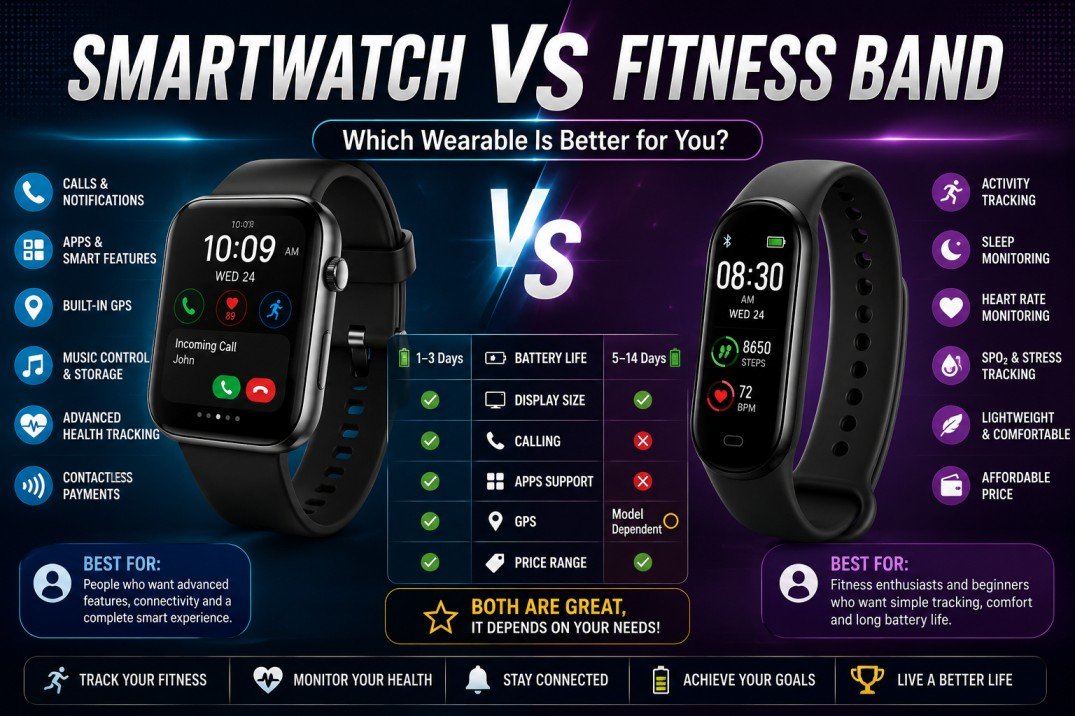
Wearable technology has changed the way people monitor their health, manage notifications and stay connected throughout the day. Two of the most popular wearable devices are smartwatches and fitness bands.
Although they may look similar, they are designed for different types of users.
A smartwatch functions like a miniature smartphone on your wrist. It can display notifications, receive calls, control music, use apps and provide health-tracking features. A fitness band usually focuses more closely on steps, workouts, sleep, heart rate and daily activity.
That is why the Smartwatch vs Fitness Band comparison matters. Buying the wrong device can leave you paying for features you never use or missing functions you actually need.
This complete NewsWavvy guide compares their design, fitness tracking, smart features, battery life, price, comfort and overall value to help you choose the right wearable.
What Is a Smartwatch?
A smartwatch is a wrist-worn digital device that combines timekeeping, health tracking and smartphone-related features.
Depending on the model, a smartwatch may allow you to:
- Receive phone notifications
- Answer or reject calls
- Reply to messages
- Control music
- Use navigation
- Track workouts
- Monitor heart rate
- Use contactless payments
- Install compatible apps
- Store music
- Use voice assistance
- Make emergency calls
- Track sleep and recovery
Smartwatches usually have larger displays and more powerful operating systems than fitness bands.
They are designed for people who want both fitness tracking and digital convenience.
Image Suggestion
Use a premium smartwatch on a wrist displaying calls, messages, GPS, heart rate and music controls.
What Is a Fitness Band?
A fitness band is a lightweight wearable designed mainly to track physical activity and everyday wellness.
Most fitness bands can monitor:
- Steps
- Distance
- Calories burned
- Heart rate
- Sleep
- Exercise sessions
- Activity goals
- Stress indicators
- Blood oxygen trends on supported models
- Daily movement reminders
Fitness bands usually have smaller screens, simpler controls and fewer smartphone-style features.
Their main purpose is to help users become more active without creating too many distractions.
Image Suggestion
Use a slim fitness band displaying steps, calories, sleep score and heart-rate information.
Smartwatch vs Fitness Band: Quick Comparison
| Feature | Smartwatch | Fitness Band |
|---|---|---|
| Main Purpose | Smart connectivity and health tracking | Activity and fitness tracking |
| Display | Larger and more interactive | Smaller and simpler |
| Calling Features | Available on many models | Limited or unavailable |
| Apps | Supported on many devices | Usually limited |
| GPS | Common, sometimes built in | Built in on selected models |
| Music | Control or storage on some models | Mostly basic controls |
| Battery Life | Usually shorter | Usually longer |
| Weight | Heavier | Lightweight |
| Comfort | Good, but depends on size | Excellent for continuous wear |
| Price | Usually higher | Usually more affordable |
| Best For | Professionals and connected users | Beginners and fitness-focused users |
Smartwatch vs Fitness Band: Detailed Comparison
1. Design and Display
One of the clearest differences is screen size.
Smartwatches usually feature:
- Larger displays
- Bright colour screens
- Touch controls
- Custom watch faces
- Detailed notifications
- More information on the screen
- Premium metal or rugged cases
Fitness bands typically offer:
- Slim rectangular displays
- Lightweight bodies
- Simple menus
- Minimal watch faces
- Compact straps
- Less screen distraction
A smartwatch usually looks more like a traditional watch, while a fitness band looks like a slim activity tracker.
Which Is Better?
Choose a smartwatch when you want a bigger, more attractive display.
Choose a fitness band when you want something light and discreet.
2. Fitness Tracking
Both devices can track everyday activity, but the depth of tracking depends on the model.
Common tracking features include:
- Step count
- Walking distance
- Calories
- Heart rate
- Sleep
- Workout duration
- Activity reminders
Advanced smartwatches may offer additional features such as:
- Detailed running metrics
- Route navigation
- Training load
- Recovery guidance
- Multisport tracking
- Elevation data
- Advanced GPS analysis
- Detailed health reports
Fitness bands usually provide the essential data most beginners need without overwhelming them with complex statistics.
Which Is Better?
A basic fitness band is enough for steps, sleep and casual exercise.
A sports-focused smartwatch is generally better for runners, cyclists, swimmers and serious athletes who want detailed data.
3. Health Monitoring
Health features have become a major selling point for wearables.
Depending on the device and region, features may include:
- Continuous heart-rate tracking
- Resting heart-rate trends
- Sleep tracking
- Stress monitoring
- Blood oxygen estimates
- Skin-temperature trends
- ECG support
- Irregular rhythm notifications
- Breathing exercises
- Menstrual health tracking
Smartwatches are more likely to offer advanced health features because they contain additional sensors and stronger software.
However, health features should not be treated as a replacement for professional medical testing. Wearable measurements are useful for understanding trends, but concerning readings should be discussed with a qualified healthcare professional.
Which Is Better?
A smartwatch is better when advanced health tools matter to you.
A fitness band is suitable for basic daily health and activity tracking.
4. Calling and Messaging
A major advantage of a smartwatch is communication.
Many smartwatches can:
- Display incoming calls
- Reject or answer calls
- Show messages
- Send quick replies
- Access voice assistants
- Display emails
- Provide app notifications
Some cellular models can make calls or stream content without keeping the phone nearby.
Fitness bands usually offer basic notification previews. Some models may allow quick responses or call controls, but they generally do not provide a complete communication experience.
Which Is Better?
A smartwatch is clearly better for calling, messaging and staying connected.
A fitness band is better when you only need simple notification alerts.
5. Apps and Smart Features
Smartwatches can support useful apps and digital tools.
Depending on the operating system, you may get:
- Weather apps
- Navigation
- Calendar
- Reminders
- Music streaming
- Contactless payment
- Voice assistance
- Workout platforms
- Productivity apps
- Travel tools
Fitness bands usually use simpler software. They focus on tracking data and displaying basic phone notifications.
This simplicity can be a benefit for people who do not want another screen demanding attention.
Which Is Better?
Choose a smartwatch for apps and connected features.
Choose a fitness band for a simple and distraction-free experience.
6. Battery Life
Battery life is one of the strongest advantages of a fitness band.
Because fitness bands have smaller screens and simpler software, they often last several days before requiring a recharge.
Smartwatch battery life varies significantly. Large displays, cellular connectivity, GPS, apps and always-on screens consume more power.
Battery performance also depends on:
- Screen brightness
- GPS usage
- Workout tracking
- Always-on display
- Music playback
- Call usage
- Health sensors
- Notification frequency
Which Is Better?
A fitness band is generally better for long battery life.
A smartwatch is suitable when you are comfortable charging more frequently in exchange for extra features.
7. Comfort and Sleep Tracking
Fitness bands are often easier to wear continuously because they are slim and lightweight.
This makes them suitable for:
- Sleeping
- Long workouts
- Office use
- Daily walking
- Travel
- All-day activity tracking
Large smartwatches can still be comfortable, but some users may find them heavy during sleep or extended workouts.
A lighter device may also produce more consistent data because users are less likely to remove it.
Which Is Better?
A fitness band is usually better for sleep and all-day comfort.
A smartwatch may be better when screen size and features matter more than minimum weight.
8. GPS and Outdoor Activity
GPS helps record distance, speed, routes and pace during outdoor activities.
A smartwatch may include built-in GPS, allowing you to record a run or ride without using the phone’s GPS connection.
Some fitness bands also include built-in GPS, while others rely on a connected smartphone.
Built-in GPS is useful for:
- Running
- Cycling
- Hiking
- Outdoor walking
- Route tracking
- Pace measurement
However, frequent GPS use can reduce battery life.
Which Is Better?
A GPS smartwatch is usually better for serious outdoor training.
A fitness band with connected GPS is enough for occasional walks or runs.
9. Music and Entertainment
Smartwatches can offer better music features.
Depending on the model, users may be able to:
- Control phone music
- Stream music
- Store playlists
- Connect Bluetooth earbuds
- Control podcasts
- Adjust volume
Fitness bands generally provide basic play, pause and track controls.
Which Is Better?
A smartwatch is better for people who exercise with music and want fewer reasons to carry a phone.
10. Price and Value
Price is an important part of the Smartwatch vs Fitness Band decision.
Fitness bands are usually more affordable because they have:
- Smaller displays
- Fewer apps
- Simpler processors
- Limited communication tools
- Basic construction
Smartwatches cost more because they may include:
- Premium displays
- Advanced sensors
- GPS
- Calling
- App support
- Music storage
- Contactless payments
- Cellular connectivity
The more expensive device is not automatically the better choice. Value depends on how many features you actually use.
Which Is Better?
A fitness band offers better value for basic activity tracking.
A smartwatch offers better value for users who regularly use its smart and communication features.
Advantages of a Smartwatch
A smartwatch offers several benefits:
- Large and attractive display
- Calling and messaging features
- Better notification management
- Advanced fitness tracking
- Built-in GPS on many models
- App support
- Music functions
- Contactless payments
- Premium design
- Customisable watch faces
It can reduce how often you need to take your phone out of your pocket.
Disadvantages of a Smartwatch
Smartwatches also have some drawbacks:
- Higher price
- Shorter battery life
- More frequent charging
- Heavier design
- Greater screen distraction
- Some features require a compatible phone
- Premium services may require subscriptions
- Cellular models may involve additional charges
Buying a feature-rich smartwatch makes little sense when you only want step counting.
Advantages of a Fitness Band
A fitness band is attractive for several reasons:
- Affordable price
- Lightweight body
- Long battery life
- Comfortable sleep tracking
- Simple activity monitoring
- Easy setup
- Less distracting
- Suitable for beginners
- Convenient for continuous wear
It provides the most important fitness information without unnecessary complexity.
Disadvantages of a Fitness Band
Possible limitations include:
- Small display
- Limited message interaction
- Few apps
- Basic navigation
- Limited music features
- Less premium appearance
- Fewer advanced health sensors
- Connected GPS on some models
- Limited calling capabilities
Users wanting a complete wrist-based digital experience may find a fitness band too simple.
Who Should Buy a Smartwatch?
A smartwatch may be the better choice for:
Professionals
It helps manage calls, messages, reminders and calendar notifications.
Serious Fitness Users
Advanced models provide GPS, detailed workout data and multisport tracking.
Smartphone Power Users
People who frequently check notifications can manage them from the wrist.
Music Lovers
Some models support music storage or independent streaming.
Travellers
Navigation, payment and communication features can be useful during travel.
Users Seeking Premium Style
Smartwatches often offer stronger design customisation and premium materials.
Who Should Buy a Fitness Band?
A fitness band may be the better choice for:
Beginners
It provides easy activity tracking without complicated features.
Budget Buyers
Fitness bands offer essential wellness tracking at a lower price.
Students
They are affordable, lightweight and simple.
Casual Walkers
Step, distance and calorie tracking may be all they need.
Sleep-Focused Users
The lighter design is often more comfortable overnight.
People Who Dislike Frequent Charging
Fitness bands generally require fewer charging sessions.
Smartwatch vs Fitness Band for Weight Loss
Neither device can create weight loss by itself.
However, both can support healthier habits by tracking:
- Steps
- Activity minutes
- Workout consistency
- Estimated calorie expenditure
- Sleep
- Heart-rate trends
A fitness band is usually enough for beginners trying to increase daily movement.
A smartwatch may be more useful for people following structured running, cycling or gym programmes.
The success of either device depends on regular use, realistic goals, nutrition and consistency.
Smartwatch vs Fitness Band for Gym Workouts
For basic gym sessions, a fitness band can track workout duration, heart rate and calories.
A smartwatch may be better for users who want:
- Detailed exercise modes
- Rest timers
- Workout plans
- Heart-rate zones
- Recovery data
- Music control
- Larger on-screen information
The right choice depends on how seriously you analyse your training.
Smartwatch vs Fitness Band for Running
Casual runners may be satisfied with a fitness band, especially when it offers reliable GPS connectivity and heart-rate tracking.
Serious runners may benefit more from a GPS smartwatch because it can provide:
- Pace
- Distance
- Route maps
- Lap data
- Cadence
- Elevation
- Training load
- Recovery insights
A specialised sports watch is often more useful than a general lifestyle smartwatch for advanced athletes.
Smartwatch vs Fitness Band for Students
Students generally benefit from a fitness band when they want:
- Step tracking
- Sleep tracking
- Basic notifications
- Low cost
- Long battery life
A smartwatch may be useful for students who need:
- Calendar reminders
- Calling
- Messages
- Navigation
- Music
- Productivity apps
A fitness band is the more practical choice for most students, while a smartwatch provides greater convenience at a higher price.
Smartwatch vs Fitness Band: Which Is More Accurate?
Accuracy depends more on the specific model, sensor quality, fit and software than on the category name.
A good fitness band may track steps and sleep better than a poorly designed smartwatch. A specialised sports watch may outperform both during running or cycling.
Accuracy can also be affected by:
- Loose straps
- Skin movement
- Tattoos
- Cold weather
- Exercise type
- Device placement
- Software algorithms
Wear the device correctly and use the data to observe trends rather than treating every reading as perfect.
How to Choose the Right Wearable
Before buying, ask these questions:
What Is My Main Goal?
Choose a fitness band for simple activity tracking.
Choose a smartwatch for connectivity and advanced functions.
How Often Will I Charge It?
A fitness band is generally more convenient for users who dislike frequent charging.
Do I Need Calling?
Choose a compatible smartwatch when wrist-based calls are important.
Do I Need Built-In GPS?
Runners and cyclists should check whether the device includes independent GPS.
Will I Wear It While Sleeping?
Look for a lightweight design and comfortable strap.
Is It Compatible With My Phone?
Some smartwatch features work best within the same device ecosystem.
Do I Need Advanced Health Features?
Check whether the desired tools are supported in your country and on your phone.
What Is My Budget?
Do not pay for features you are unlikely to use.
Final Verdict
The Smartwatch vs Fitness Band decision depends on your lifestyle, goals and budget.
Choose a smartwatch when you want:
- Calls and messaging
- A large display
- Apps
- Music features
- Navigation
- Advanced fitness tools
- Premium design
Choose a fitness band when you want:
- Step tracking
- Sleep monitoring
- Basic workouts
- Long battery life
- Lightweight comfort
- Affordable pricing
- Simple operation
A smartwatch is the better all-round digital device. A fitness band is the better focused activity tracker.
The best wearable is not the one with the longest feature list. It is the one you will wear regularly and use consistently.
FAQ About Smartwatch vs Fitness Band
What is the main difference between a smartwatch and a fitness band?
A smartwatch combines communication, apps and fitness tools, while a fitness band focuses mainly on activity, exercise and sleep tracking.
Which is better in Smartwatch vs Fitness Band?
A smartwatch is better for calls, notifications, apps and advanced features. A fitness band is better for basic tracking, battery life, comfort and affordability.
Is a fitness band more accurate than a smartwatch?
Accuracy depends on the individual device, sensor quality, software and fit. Neither category is automatically more accurate in every situation.
Which device has better battery life?
Fitness bands generally provide longer battery life because they use smaller screens and simpler software.
Can a fitness band answer calls?
Most fitness bands only display call alerts. Some advanced models may offer limited calling controls, but complete call functionality is more common on smartwatches.
Which is better for sleep tracking?
Fitness bands are often more comfortable for sleep tracking because they are lighter and smaller.
Which is better for running?
A GPS smartwatch is usually better for serious running. A fitness band can be sufficient for casual runs and step tracking.
Is a smartwatch worth the higher price?
It is worth the higher price when you regularly use calls, messages, GPS, apps, payments, music or advanced workout tools.
Can a smartwatch work without a phone?
Some cellular smartwatches can handle selected features without a nearby phone. Other models still require a paired smartphone for full functionality.
Which wearable is better for beginners?
A fitness band is usually better for beginners because it is affordable, simple and focused on essential activity tracking.
Can wearable devices replace medical equipment?
No. Wearables can help monitor trends, but they should not replace professional diagnosis or medical devices.
Which wearable should a student buy?
A fitness band is usually the most practical choice for students. A smartwatch is suitable when calling, navigation and productivity features are important.